Right, first of all. To the people who contacted me based on the last blog post, thanks. It wasn't really as bad as it seemed. I'm not really drowning, rather, as Nate said, "You just like to make a show of flailing." He's right about that; I do have a bit of a melodramatic side. I'm sorry if I caused any of you any distress. I'll do my best to restrain myself in times of silly post-adolescent angst.
Now, my current predicament. I've been sick since around 10pm Monday night, and it shows no sign of letting up. Nate is bringing me apothecary of some kind to fix my ailments, but while I sat here on sectional-love-seat feeling completely justified in my complete and utter lack of academic progress over the past two days, an interesting little concept wormed its way into my fever-addled mind like a ribbon from a flying nun's untidy bun falling to the ground.
The thought was this: GONZO JOURNALISM! Or, perhaps more appropriately stream of consciousness based off of your/my altered state due not to hallucinogenic drugs, or other hedonistic enterprises, but due instead to two days of podcasts, oranges, NPR, an Underground Comics Collection, and stumbleupon. I realize that this is far from the true (aka:
Wikipedia) definition of Gonzo Journalism, but whatever. I thought of
Hunter S. Thompson anyway because I am uncultured in terms of counter-cultural movements outside of Christian Fundamentalism. To be honest, most of what I know of HST comes from the future-version named
Spider Jerusalem from
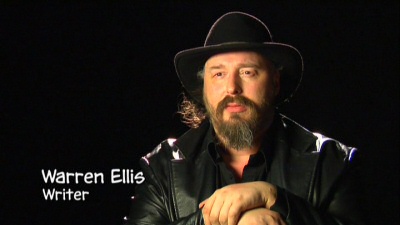
Warren Ellis' Transmetropolitan.
But I'm loosing myself already.
Here's the thing, I spent probably too much time today researching some of the more extreme wings of Protestant Christian Fundamentalism. We're talking people who are convinced that
the Roman Catholic Church started both Nazism and Communism, and that
Jesuits are
Illuminati hellbent on... um... doing vague but definitely evil things. I started reading stories of people who went on speaking tours, and wrote multiple books about their sordid history of witchcraft, freemasonry, satanism,
Dungeons and Dragons, paganism, ritualistic magic, and in one especially odd case,
vampirism. These people were embraced by the kind of people who went to my home church around the time that all these things were being debunked, either by Brittish Journalists (
Gonzo?) or Christian publications like
Christianity Today and the now defunct
Cornerstone.
Then I read this
blog post. It's completely void of citations, but for a vast majority of the content I found that unnecessary. Most of those ridiculous things (the
Smurfs are satanists?[Meta-moment:
overgrown Smurfs are
satanic?]) I heard from my mother, or my friends, or my friends' mothers. Right, so... at this point we'll assume that I grew up in a hotbed of fear and epic lunacy. Right, not a problem. I knew that already.
Oh, yeah, and that hotbed of fear and epic lunacy still exists (see: Overgrown Smurfs). Yeah, not a problem. Thank God that I was somehow spared the the ideological brainwashing that would have most assuredly turned me into one of
these someday. By the way,
they're still allowed to do what they do, score one for the first amendment. Who said ideals were easy? Nobody? I just made myself look like a bitter little boy? Sorry guys. Seriously though, intellectually I have to agree with this, but something tacit hurts.
Where was I? Right! Crazies! So, I'm feeling discouraged and worried about where I came from, and I'm wondering how to prevent myself and others (not gonna lie, I'm thinking about my chillens here, cuz I is sentimental) from ending up back there. And, so I goes to this neat little
website species-wide-phenomena (1 in 12 people ON THE PLANET) called Facebook. And one of my (anonymous) friends had posted a little something that was just as ridiculous (in a sense, I'm getting there) as the stupid things that lead my friend in 3rd grade to burn his Pokemon cards (as they were giving him headaches and nightmares). It was this statement, "At its heart, [Christian] Fundamentalism represents male insecurity and anger at the perceived 'feminization' of the church. Yet another proof that gender roles are at the root of so many of our problems." Which made me go
ARGH!
Okay, before the feminists who love me decide to burn me and send a message to the others, allow me to say that I am also a
feminist. Here is where I take issue, it is the condensation of a huge cultural movement/artifact to some unified, antagonistic, diabolical root. Whether this root is as theory specific as "
The Male Gaze," as unlikely as "
The Illuminati run by
Vanilla Ice", as scientific as
"Greenhouse Gas Emissions," or as impossible to disprove as
"Old Scratch Hisself," whenever a thing as large as a cultural movement/artifact is reduced to a single factor, we all become fundies.
Humanity wants to have a villain. If my pseudo-mythologist mentality has taught me anything, it's that a story without an antagonist isn't going to make it very far. At our most basic core, we want to believe that all the bad stuff is caused by something
specific, something with a
face, something we can
fight, something
identifiable. Altogether too often, we take the materials in our general vicinity and create the monster from whatever our zeitgeist happens to
fear at the moment.
The thing most easily available to us is, unfortunately, our neighbors. See that couple across the street? Yeah. He's a witch/communist/satanist/Muslim/Fundie/Mormon/Republican. Oh, goodness, does the poor girl know? Of course she knows, the bitch is in on it. Let the public
execution begin. To reduce anyone to a single idea or concept is to strip them of their humanity and create of them an embodied ideal. This is how we make heroes, and this is how we make villains.
Maybe this is a little depressing, but... I gots some bad news for y'all. Heroes don't
exist, and neither do Villains. Not in this sense. Every human being is so complex and multi-tiered that the labels of
Hero and
Villain apply about as much as the label
Fruit applies to a banana protein shake from
Jamba Juice.
Here's my point. Humanity is complicated, very very complicated. If you come to a simple conclusion that answers more questions than it asks about the human condition, then please
Go to Jail, Go Directly to Jail, Do Not Pass Go, Do Not Collect $200. And, while you're in Jail look around and look inside and admit the fact that you can't explain the mess out there any more than you can explain the mess in there and have a little compassion, huh? I here Jail isn't a very compassionate place, so maybe go to a monastery or something, like
Connor Hawke did.
Perhaps this is the mystical in me coming out, and perhaps I'm absolutely wrong and blinded by my post-modern milieu (every time someone uses that word I feel like their reasons are as follows: 20% to make a point, 80% pretention). But I believe that I believe (
WE MUST GO DEEPER!!) that human beings would treat one another better if we would stop trying to explain or understand and tried instead to make the world a better, more loving, less angsty place on our exit than on our entrance.
Also,
Gandhi.


 Posts
Posts