Europa is one of the six moons of Jupiter. It's an ocean moon, but without much of an atmosphere to trap heat, the ocean is covered in a thick layer of ice. No one knows what exists, or perhaps lives, in the depths of that ocean. But, lifeless or otherwise, we do know that the ocean of Europa is a turbulent place. The tides on planet Earth are mainly influenced by our own celestial little sibling, the moon. Europa has it the other way around, and then some. Europa's tides are predominately dictated by the gravitational pull of Jupiter, but the other five moons of Jupiter also have their own effects which are far from incidental.
With the combined weight of six heavenly bodies having their say on the shift and flow of the liquid world, the currents under Europa's ice are like that unto a worldwide typhoon. Or perhaps six worldwide typhoons, competing for dominance over control of the ocean's flow. The water on Europa is constantly shifting, moving, battling itself. The tide of Callisto crashes into the tide of Io with the eruptive power of a nuclear warhead. The tides of Ganymede and Jupiter VI try to pull away from the tide of father Jupiter himself, as water rises and falls from the corners of the tide, like six iterations of Niagara falls in reverse. The churning miasma shakes the interior of the planet, like a child shakes a snowglobe.
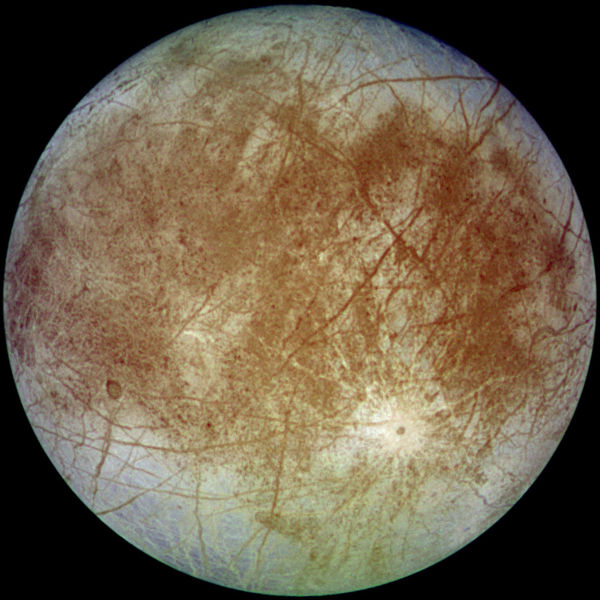
Meanwhile, the placid surface of the moon does not go unaffected. Europa is covered in linea, which is just the Latin word for lines. Linea are gigantic cracks in the ice that stretch for hundreds of miles across the surface of the frozen world, the tectonic result of the chaos below. These cracks appear in straight lines, gigantic gouges across the glittering landscape of the moon. Orderly stress fractures, almost in opposition to the watery chaos that created them.
Europa is still cooling. The older linea are more prevalent, and as time passes, and the ice thickens, linea become infrequent occurrences, and the old ones become shallower, less distinct. There will always be scars on the planet's surface, but they will pale in comparison to the deep wounds they once were. Europa is coalescing from a confused and chaotic mess of water, ice, and mud into a serene, frozen moon.
At least, that's the plan. But, the waters are not an easy thing to tame. Europa has taken millions of years and suffered the creation of thousands of linea to get to the semi-tranquil place it is today, but it would not take much to set the entire process back to the beginning. All it would take is a large stray asteroid from Jupiter's ring, or one rogue comet to brush Europa's gravitational field, and the uneasy balance would be thrown into chaos.
Europa has had its scares before. Minor meteors have affected the surface of the moon with little frozen craters. Inconsequential blemishes on an otherwise smoothing surface. But, Europa has never truly faced The Big One. Meteors can crack ice, but something with serious gravity could reach through the glacial hull and agitate the already furious waters below. The oceans would revolt. Geysers tall as mountains would erupt from the brittle shell. Tidal waves of ice would sweep across frozen plains sending shards of frigid arrows cascading in every direction. Linea deep and long enough to put any previous to shame would develop, and the crystalline sphere of Europa would take on the optical qualities of the universe's largest disco ball.
So, if you ever find yourself mindlessly watching PBS at 2 am and you stuble across another low budget episode of Jack Horkheimer: Star Gazer, and Jack mentions that Jupiter is quite visible this time of year. Or, if you happen to be gazing up at a brilliant sky and you notice that gas giant hovering just over the horizon. Look up and offer a prayer for the anxious Europa, trying to hold everything together, trying to mature into a solid, stable world, but constantly beset by the torment of possible complete relapse into chaos. Next time you follow Uncle Jack's advice and stargaze, pause for a minute, and have some sympathy for the heavens.


 Posts
Posts


No comments:
Post a Comment